In fluid handling systems, check valves perform a critical yet often overlooked function by preventing reverse flow, protecting pumps, and preserving overall system stability. Though their function seems simple, an incorrect valve choice might cause too much pressure decrease, vibration, water hammer, and hastened component wear. These problems might have a direct influence on equipment lifetime, system performance, and unanticipated repair expenses.
Evaluating swing, lift, dual plate, and wafer check valves sometimes causes difficulties for engineers and procurement teams, especially when service conditions, flow behavior, and operating pressures change across uses. Supported by practical manufacturing and field experience from SVR Global, a trusted manufacturer in USA, the emphasis remains on reliable performance under real operating conditions rather than theoretical assumptions.
What Is a Check Valve?
An automatic valve called a check valve closes when flow reverses and lets flow go only in one direction. It runs using line pressure, gravity, or spring force, rather than outside action. Unlike isolation valves, check valves keep reacting to variations in flow conditions. Pressure drop, closing speed, and system safety are all directly affected by their internal structure.
Core functions
- Prevent reverse flow and back pressure across connected piping systems
- Protect pumps, compressors, and flow meters from damage and efficiency loss
- Maintain directional flow integrity under fluctuating operating pressure conditions
- Reduce risk of water hammer when correctly selected and properly installed
Check valves are widely used in water treatment plants, oil & gas facilities, thermal power stations, chemical processing units, HVAC systems, and fire protection networks.
Working principle
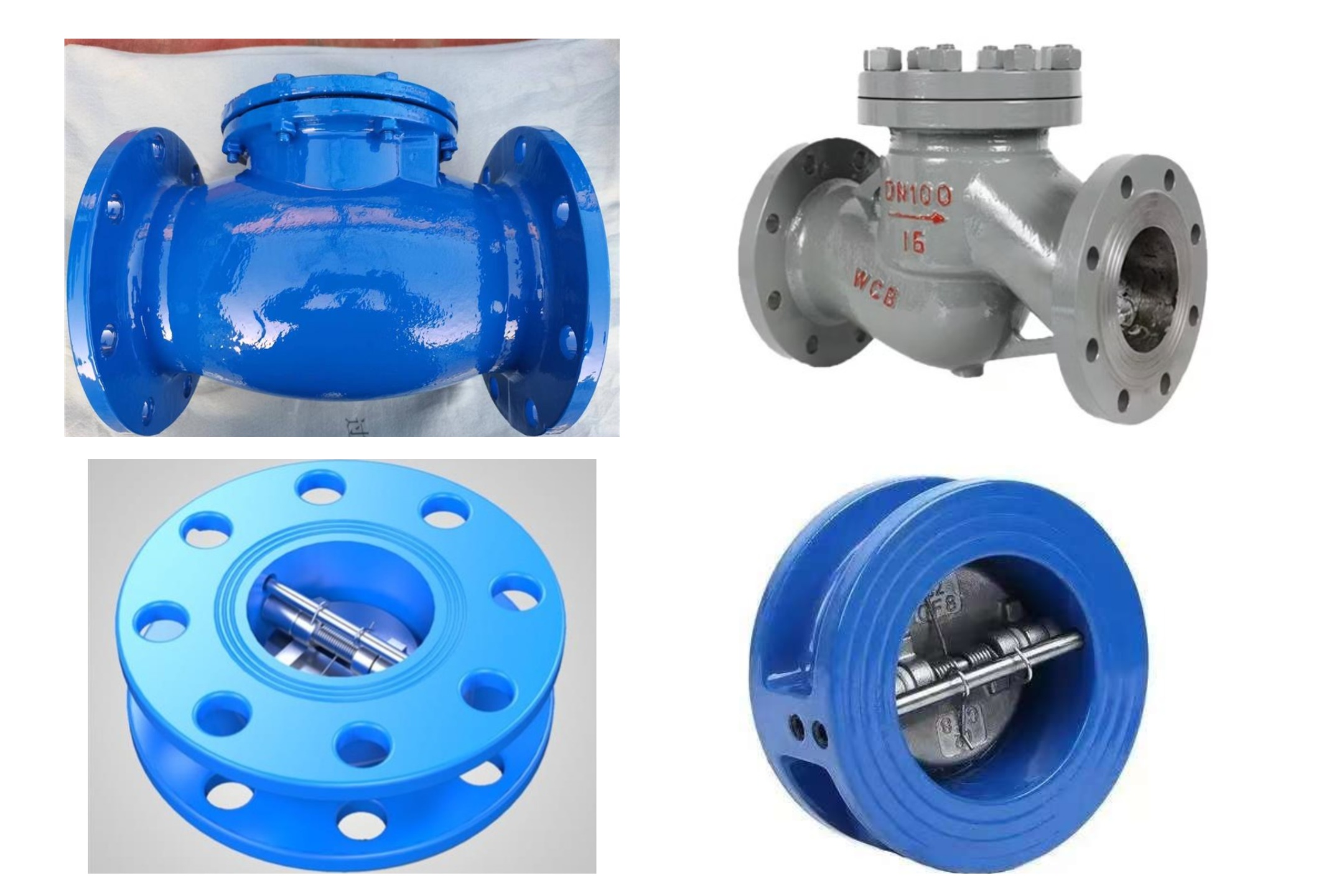
Under forward flow, a swing check valve has a hinged disc that moves away from the seat. When flow reverses or slows down, gravity or back pressure causes the disc to come back to its seat, therefore stopping reverse flow.
Typical technical ranges
| Parameter | Range |
| Size range | DN 50 – DN 1200 |
| Pressure class | PN 10–PN 40 / Class 150–300 |
| Temperature range | –10°C to +425°C |
| Materials | Cast iron, ductile iron, carbon steel, stainless steel |
| Standards | API 594, ASME B16.34, EN 12334 |
Best-suited applications
- Low-velocity pipelines
- Large-diameter water transmission lines
- Cooling water systems
- Horizontal installations with steady flow
Key advantages
- Minimal pressure drop due to full bore opening
- Tolerant to suspended solids
- Low maintenance requirement
Engineering considerations
- Slow closing may cause water hammer in high-flow systems
- Not recommended for vertical downward flow
- Disc slamming possible without dampening devices
Working principle
Lift check valves work by having a guided disc or piston move up and down when the pressure coming from upstream is more than the pressure coming from downstream. The disc returns to the seat when flow ceases, therefore ensuring tight shut-off.
Typical technical ranges
| Parameter | Range |
| Size range | DN 15 – DN 300 |
| Pressure class | PN 16–PN 100 / Class 150–600 |
| Temperature range | –29°C to +540°C |
| Materials | Carbon steel, stainless steel, alloy steel |
| Standards | API 594, ASME B16.34 |
Preferred applications
- High-pressure process lines
- Steam, condensate, and boiler feedwater systems
- Oil & gas pipelines
- Vertical lines with upward flow
Key advantages
- Tight sealing under high differential pressure
- Controlled and guided disc movement
- Suitable for severe pressure conditions
Limitations
- Higher pressure loss compared to swing check valves
- Requires clean media to prevent disc sticking
- Less effective in low-flow applications
Working principle
Two spring-loaded half-discs set on a middle hinge pin define dual plate check valves. The plates close quickly when flow reverses to lower pressure surges and open with forward flow.
Typical technical ranges
| Parameter | Range |
| Size range | DN 40 – DN 900 |
| Pressure class | PN 10–PN 40 / Class 150–300 |
| Temperature range | –50°C to +350°C |
| Materials | Ductile iron, carbon steel, stainless steel |
| Standards | API 594, EN 12334 |
Common applications
- Pump discharge lines
- High-velocity systems
- Fire protection networks
- Compact piping layouts
Key advantages
- Fast closing minimizes water hammer
- Lightweight construction reduces pipe stress
- Short face-to-face dimension saves installation space
Limitations
- Spring fatigue in abrasive or corrosive services
- Slightly higher pressure drop than swing valves
- Correct spring selection critical for long-term reliability
Wafer Check Valve
Working principle
Wafer check valves are installed between flanges and typically use a single disc or spring-assisted closure mechanism. Their compact body design makes them suitable for space-constrained installations.
Typical technical ranges
| Parameter | Range |
| Size range | DN 25 – DN 600 |
| Pressure class | PN 10–PN 40 / Class 150 |
| Temperature range | –20°C to +300°C |
| Materials | Stainless steel, carbon steel, duplex steel |
| Standards | API 594, EN 1092 |
Suitable applications
- HVAC circulation systems
- Water distribution pipelines
- Chemical and process skids
- Utility services with limited installation space
Practical advantages
- Easy installation and flange alignment
- Reduced weight compared to flanged designs
- Cost-effective for moderate pressure services
Comparison Overview
| Valve Type | Pressure Drop | Closure Speed | Typical Use |
| Swing | Low due to open flow path | Slow, gravity-assisted | Large pipelines, water transmission, low-velocity systems |
| Lift | High from guided disc design | Fast response | High-pressure lines, steam and oil & gas services |
| Dual Plate | Medium, spring-influenced | Very fast closure | Pump discharge, fire protection, high-velocity systems |
| Wafer | Medium due to compact body | Fast and controlled | HVAC systems, utility lines, compact installations |
Key Selection Factors Engineers Should Consider
Beyond size and pressure rating, proper check valve selection depends on multiple measured parameters:
- For liquids in regular process pipelines, flow speed usually varies between 1.5 and 3 m/s.
- Under regular and maximum operating conditions, differential pressure over the valve
- Properties of media include being clean, abrasive, corrosive, viscous, or containing suspended solids.
- Horizontal, vertical upward, or vertical downward flow installation orientation
- Temperature cycling and thermal expansion’s influence on sealing parts
- Pressure surge possibilities during pump start-up, shutdown, or abrupt valve closing
Procurement teams should also confirm:
- Compliance with API, ASME, or EN standards
- Hydrostatic and seat testing as per API 598 or ISO 5208
- Material traceability and EN 10204 3.1 certification
This is where working with an experienced Manufacturer in USA ensures predictable performance and compliance across projects.
Why Manufacturing Quality Matters?
Check valves frequently fail due to poor spring calibration, bad machining tolerances, or changing material quality. Surface finish flaws, wrong heat treatment, and misaligned seating surfaces are more elements lowering operational dependability. Precision manufacturing ensures:
- Accurate disc alignment
- Reliable sealing performance
- Controlled closing response
- Longer service life under cyclic operation
Proper inspection, hydrostatic pressure testing, seat leakage verification, and dimensional checks play a critical role in achieving dependable valve operation in real plant conditions and demanding industrial environments.
Conclusion
Swing, lift, dual plate, and wafer check valves have different operating needs. Performance relies on flow circumstances, pressure class, temperature range, and installation limits; no one solution is appropriate for every system. The valve choice process also has to include a thorough examination of media qualities, flow speed, maintenance access, and pressure surge risks.
By working with a proven Manufacturer in USA like SVR Global, engineers and plant managers gain access to check valve solutions designed for reliability, standards compliance, and long-term service life.
Early in the design phase, examining technical criteria for projects when valve performance directly affects uptime and system safety will help ensure improved functioning and less surprises during commissioning.